
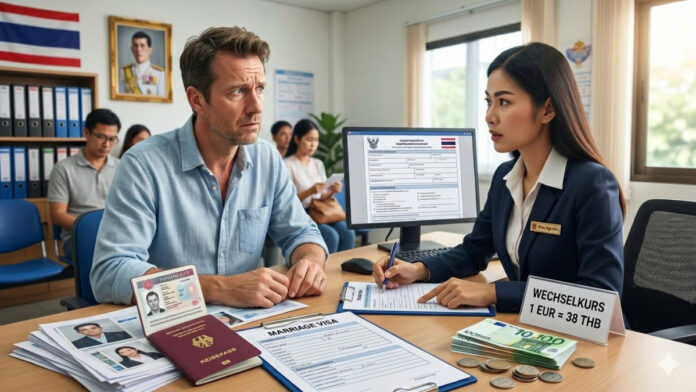
BANGKOK, THAILAND – Marriage visa applicants face unexpected scrutiny as immigration authorities deepen their investigation into genuine relationships.
System Change for Visa Seekers
Individuals who have resided in Thailand for years using the Thailand Privilege Card and wish to switch to a Non-Immigrant O visa for marriage will encounter a more comprehensive system than anticipated. While the Privilege Card program focuses on financial means and a clean criminal record, the marriage visa demands proof of an authentic, lived partnership. This includes intimate details such as photos from the bedroom, hand-drawn location plans, and interviews with neighbors by officials, illustrating clear departmental logic.
This guide aims to clarify the exact requirements of the Immigration Bureau for the Non-O marriage visa and explain why officials delve so deeply into personal lives. The process signifies a substantial change from the privileges offered by the former Elite Visa program.
Changes in Switching from Privilege Program to Marriage Visa
The Thailand Privilege Card, previously known as the Elite Visa, functions as a tourist visa with enhanced benefits. Immigration verifies the source of funds and a clear background, granting residency for five to twenty years, with no requirement for actual residency in Thailand. However, those marrying and seeking to transition to the Non-Immigrant O visa on the basis of marriage enter a fundamentally different category with a distinct examination process.
The marriage visa mandates proof of a genuine, ongoing partnership. Applicants must demonstrate either 400,000 Baht in a Thai bank account, frozen two months before the initial application and three months prior to each annual renewal, or a minimum monthly income of 40,000 Baht. Additional documents include Amphoe marriage certifications (Kor Ror 2 and Kor Ror 22), a legalized marriage certificate, and a residential plan. This constitutes the basic requirement; the actual scrutiny goes further.
Why Immigration Demands Bedroom Photos
Bogus marriages for the purpose of obtaining residency are a significant concern for Thai immigration. Consequently, applicants for a marriage visa, or its annual renewal, must actively prove their marriage is not merely a formality. The standard method for this is a compiled set of photographs.

Applicants are required to submit pictures of the couple together in various settings: in front of their home with a visible house number, in the living room, the kitchen, and the bedroom. These are not to be selfies and must be printed on photo paper and affixed to A4 sheets. This practice has been standard for years, applied to both initial applications and renewals.
While some offices, such as those in Bangkok Chaengwattana and Phuket, are known for their stringent enforcement, requirements can vary. Officials cross-reference the address numbers in the photos with TM30 receipts and rental agreements. Discrepancies necessitate re-photographing. Some offices schedule home visits, while others arrive unannounced to interview neighbors.
What Visa Agencies Provide and What Immigration Examines
Engaging a visa agency can assist with documentation and the bureaucratic process. However, personal inquiries about household arrangements—such as a divided kitchen or shared bedroom—are posed by immigration officials, not the agency, during interviews or home visits. Reputable agencies prepare their clients to avoid contradictions during these interactions.
Experienced agencies are aware of discrepancies that can trigger immigration suspicion. These include differing registered addresses for spouses, photographic evidence of separate sleeping areas, or a spouse unable to identify the apartment’s floor during an interview. Thorough preparation transforms these questions into a routine process rather than an interrogation.
Grey Areas: When Agencies Become a Risk
Not all service providers operate ethically. Some in the industry facilitate fraud, falsifying documents like residence papers, embellishing bank statements, or fabricating addresses. Such actions are criminal and pose direct risks to the client.
The risk to the client is substantial, given the increasing collaboration between immigration, tax authorities, and banks. Caught providing false information can lead to visa cancellation, fines, and, in severe cases, a multi-year re-entry ban, jeopardizing retirement plans in Thailand. A reputable visa consultancy will only request documents legally mandated, not extraneous items.
Data Protection: What Agencies Can Do with Personal Data
Thailand’s Personal Data Protection Act (PDPA) provides a legal framework for handling sensitive information. Visa agencies are obligated to secure private data and use it solely for the agreed-upon purpose. In practice, enforcement remains challenging.
Individuals who share personal details about their family life, sleeping habits, or financial situation with an agency may lose some control over this data. It is legitimate to inquire about the necessity of specific information and whom it will be shared with. An agency unwilling or unable to provide such answers is not a reliable partner. Clients receiving document lists extending beyond marriage certificates, bank statements, and proof of residence should investigate further.
What Needs to Be Done Now
Individuals planning to transition from the Thailand Privilege Card to the Non-O marriage visa should begin addressing the financial prerequisites early. The 400,000 Baht must remain untouched in a Thai bank account for at least two months before the initial application; delaying this can lead to failure solely due to time constraints.
Both partners should jointly take the required photographs: professionally captured, with visible house numbers, in all four requested rooms. Selfies will not be accepted. For external support, a licensed lawyer generally offers more security than a general agency, as lawyers are bound by professional duties that commercial intermediaries lack. Independent visa consultants can also provide pre-application advice. The fundamental principle remains: properly documenting genuine circumstances eliminates the need for nervousness, whether during the application process or an unannounced home visit.