
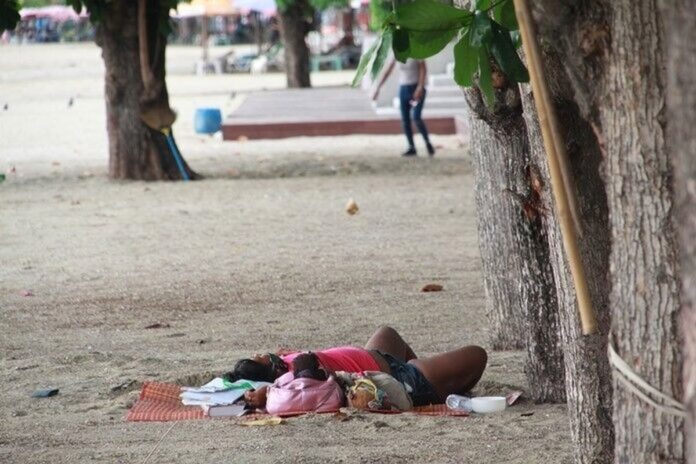
PATTAYA, THAILAND – The arrival of the off-season in Pattaya has revealed a stark, growing problem of homelessness, with abandoned buildings becoming makeshift shelters for those with nowhere else to turn.
Milder tourist numbers have brought to light issues that the peak season often conceals. Abandoned bars, closed shops, and empty structures are now occupied by people who have no other options for shelter. An inspection on June 2, 2026, across several tourist areas of Pattaya demonstrated that the off-season is reshaping the city’s appearance more profoundly than official accounts suggest.
The visible presence of homelessness is not a new issue but is demonstrably increasing. Local residents have reported a rise in individuals taking up residence in vacant properties at night. This situation, marked by accumulated trash, leftover food, and personal belongings, remains unaddressed by any existing statistics, plans, or city administration budgets. Each year, as the off-season commences, the same challenge resurfaces.
Empty, Yet Occupied
Pattaya has seen a significant number of businesses cease operations in recent years. Many bars, unable to reopen after the COVID-19 pandemic, and restaurants that shut down permanently following the decline in Chinese tourism in 2024 and 2025, have left behind structures devoid of essential services. Despite lacking electricity and water, and often missing doors, these buildings offer a better alternative than living on the streets for those without housing.
One bar owner in South Pattaya candidly stated that those who close their establishments and leave the properties unattended should not be surprised when people move in. He emphasized that these individuals are not acting out of criminality but out of necessity, a perspective the city has thus far failed to adequately acknowledge.
The Recurring Pattern
It is true that Pattaya undertakes clean-up efforts. In October 2025, a coordinated operation along Thappraya Road and Soi Yensabai involved the Social Welfare Department, the Environmental Office, and city police. Further checks were conducted in Jomtien in February 2026 following complaints from residents and business owners. In March, an inspection at Pattaya Beach led to the encounter of eleven individuals.

Each of these operations yields a similar outcome: individuals are taken to the Chonburi Protection Center, only to return. The center provides voluntary accommodation, rehabilitation programs, and vocational training. However, those who choose to leave often find themselves back in their previous circumstances, a reality even the authorities acknowledge.
Causes Known to the City
Pattaya City Hall is aware of the contributing factors to homelessness. In April 2026, the City Council’s committee for homeless assistance convened and approved a new strategy: reducing bureaucracy, accelerating immediate aid, and prioritizing long-term rehabilitation over short-term displacement. Vice Mayor Damrongkiat Pinitchan spoke of an action plan for the 2026 fiscal year, a commitment voiced in similar terms for years.
The underlying causes are well-understood: job loss, family breakdowns, a lack of affordable housing for low-income individuals, mental health issues, and addiction. Pattaya’s economy is heavily reliant on tourism and services. Consequently, any reduction in tourism—such as the 18 percent drop in foreign visitors in January 2026 compared to the previous year—disproportionately affects those with the fewest financial safeguards.
What Residents Experience
Those living near these derelict buildings often hold a conflicted view of the situation. While no one wishes to see people living on the streets, concerns arise regarding nightly noise, accumulating refuse outside homes, and uncertainty about the identity and condition of those occupying the premises. These are not abstract worries but daily realities for residents in affected neighborhoods.
One resident succinctly expressed the dual need: assistance for the homeless and support for the local community. The city has struggled for years to address both simultaneously, resulting in problems being shifted rather than resolved. Individuals removed from Pattaya Beach may reappear in Jomtien, and those checked in Jomtien often move elsewhere. The persistent cycle, as observed by daily witnesses, has been extensively documented.
Pattaya in the Off-Season Mirror
In April 2026, a 42-year-old homeless man was found deceased on an overgrown vacant lot on North Road 2. This site, lacking electricity and water, featured a fence with a gap for an entrance and was choked by three-meter-high weeds. Another homeless individual identified the deceased. The cause of death remains unclear due to the condition of the body, representing a grim conclusion to one individual’s struggle.
The off-season has a way of exposing what the peak season obscures. As fewer tourists traverse the streets, underlying issues, previously in the background, become apparent. Pattaya presents two faces—not as a metaphor, but as a factual description. Residents are privy to both; visitors typically only witness one.
Vacancy as a Symptom
The core issue underlying the visible problem is property vacancy. Pattaya possesses an excessive number of buildings whose caretakers have disappeared. These include owners who gave up post-pandemic, investors awaiting better times, and properties that legally exist but have been effectively abandoned. Individuals falling through the cracks are compelled to reside in these spaces due to a lack of alternatives.
Cities that have successfully managed this issue have not relied on increased police presence. Instead, they have established accessible, low-threshold contact points located within the communities where the affected individuals reside, rather than in distant administrative centers. Pattaya is discussing such solutions, but implementation is yet to occur.
What is Now at Stake
Pattaya aspires to reinvent itself, moving away from mass tourism towards higher quality offerings, according to its official narrative. This goal is not misguided. However, a city aiming for quality must also attend to those left behind by the previous economic model. An empty shopfront occupied by multiple individuals seeking shelter is not a marginal tourism issue; it is a benchmark of how seriously a city takes its own stated ambitions.
While the action plan for 2026 is in place, the necessary structures to ensure its effectiveness before the next peak season obscures the problem are still lacking. Long-term residents intimately familiar with Pattaya hold no illusions, yet they harbor an expectation that a city generating billions of baht in tourism revenue can offer more than clearing operations and cyclical returns.