
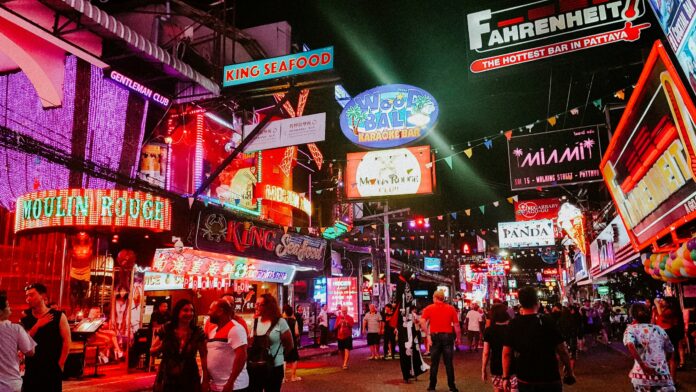
BANGKOK, Thailand – Thailand’s sex industry stays illegal yet remains wide open. After an Australian murdered a 17-year-old Thai, safety of sex workers and the nightlife economy take centre stage again.
From Soi Cowboy in Bangkok’s Sukhumvit area to Pattaya’s Walking Street, nightspots still pull in visitors from across the globe. More than 200,000 sex workers operate across the country.
Swing foundation puts number at over 200,000
Surang Janyam, director of the Service Workers in Group Foundation, known as Swing, said Thailand has more than 200,000 sex workers. Most work in Bangkok and Pattaya.
Swing is a non-profit that fights for equal rights and provides education and healthcare to service-sector employees. In Pattaya alone, more than 50,000 sex workers are believed to be active.
Pattaya night economy brings in billions
The city’s night economy brings in an estimated 100 to 200 billion Baht each year. Walking Street stands as the centre of the sex industry.
Tourism authorities try to distance themselves from that image, marketing Pattaya as a family-friendly destination and pushing for high-end travellers. But the sex trade remains impossible to ignore.

Grey zone opens door to bribes and blackmail
Thanet Supornsahasrungsi, president of the Association of the Chonburi Tourism Federation, said Pattaya wants to market itself as a family destination. At the same time, entertainment venues and massage shops secretly offer sexual services.
This grey zone can give officials opportunities to demand bribes or blackmail employees.
said Thanet, president of the Association of the Chonburi Tourism Federation.
Post-pandemic shift to freelance and social media
According to Swing, the industry did not slow down after the pandemic. Many entertainment venues closed, but some sex workers switched to freelance work and offered services through social media.
The workforce is also becoming more gender-diverse, Swing said. Sex workers are part of the tourism sector because their customers also visit other places in the city and use other services.
Fewer arrests under new penalty law
Thai police data shows 19,648 people were arrested for prostitution offences in 2023. That number was 38,139 in 2022.
Since the Administrative Penalties Law of 2022, violations of Section 5 of the Prostitution Act are punished only with fines and no longer treated as criminal offences. Responsibility shifted from police to officials at the Ministry of Social Development and Human Security.
Penalties reduced to community service
In many cases, those affected can be ordered to do community service instead of serving jail time, according to Swing. The group argues that the illegal status effectively locks sex workers out of the regular labour market and parts of the economy.
The law treats them merely as objects and not as people who have certain rights.
said Surang, director of Swing.
Swing calls for scrapping 1996 law
Swing demands the abolition of the 1996 law and the decriminalisation of sex work for people aged 18 and older. That would let sex workers benefit from labour law, social security and state support — and pay taxes.
Anti-human-trafficking laws could still be enforced to protect minors and people forced into sex work, the group says. Decriminalisation would not necessarily mean more people enter the profession, Surang said.
Murders and assaults push safety to the forefront
Swing supports sex workers who have been attacked or abused by customers and helps them work with police. The organisation accompanied the family of a trans woman who was murdered and mutilated all the way through the trial and to a compensation order.
The family of the 17-year-old teenager murdered by the Australian also received support. According to Swing, police are now more aware of the problems sex workers face and their social impact.
Workshops bring police and sex workers together
Officers less often see sex workers solely as criminals and pursue them less with inflated or excessive charges. In workshops in Pattaya, Swing regularly brings officials and sex workers together to improve understanding and reduce conflict.
Swing wants a ministerial regulation that guarantees fair wages, social support and labour rights until the law is abolished. After decriminalisation, police and administrative officials would need training for the new system, the group said.
Thanet wants a designated red-light district
Thanet instead proposes a designated red-light district with zones and state control. That could protect visitors who want to avoid such offerings and at the same time improve Pattaya’s safety and public image.
Surang rejects the proposal because a vague regulation outside the zone could, in her view, encourage bribery and corruption. The debate over the future of Thailand’s sex trade shows no signs of cooling down.