
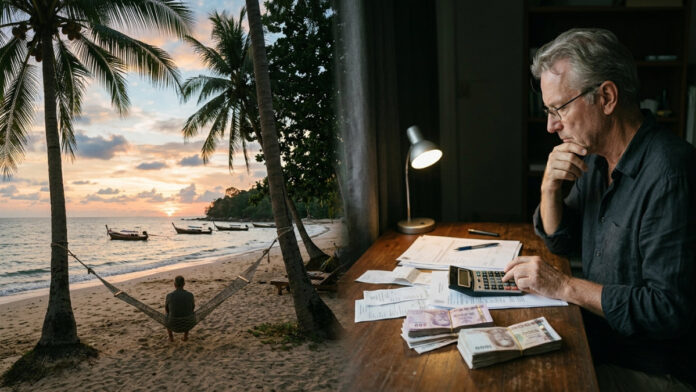
BANGKOK, Thailand – Expats planning retirement in Thailand are waking up to the harsh reality that returning home may become financially impossible.
Many individuals who moved to Thailand for sunshine, low living expenses, and a relaxed lifestyle are discovering that the cost of returning to Germany, Austria, or Switzerland could exceed their available funds. This situation is affecting a growing number of expatriates after a decade or more in the country.
This guide outlines the financial tipping points that many expats only recognize when it’s too late and offers concrete steps to avoid the repatriation trap, regardless of how long they have resided in Thailand.
Wechselkurs: Kleines Minus, große Wirkung
Expats who relocated to Thailand a decade ago recall exchange rates of up to 42 Baht per Euro. Currently, the EUR/THB exchange rate hovers between 37.8 and 38.1 Baht, representing a decrease of nearly ten percent. For a monthly pension of 1,500 Euros, this translates to approximately 6,000 Baht less per month compared to better times. This deficit accumulates to over 70,000 Baht annually.
The core issue is that living costs in Thailand have been steadily increasing, while pensions from Germany, Austria, and Switzerland often fail to fully compensate for this trend. Those who have meticulously calculated their budgets are now facing a double blow: a weaker exchange rate and escalating local prices.
Das Visum und seine Finanzanforderungen
The retirement visa, officially an extended stay permit based on a Non-O visa, requires either a permanent deposit of 800,000 Baht in a Thai bank account or a proven monthly income of at least 65,000 Baht. At the current exchange rate of roughly 38 Baht, 65,000 Baht equates to about 1,710 Euros per month, net before Thai taxes.

Those utilizing the income method must also receive a monthly international bank transfer with a traceable Foreign Telegraphic Transfer (FTT) code. Individuals opting for the deposit method must maintain a balance of 800,000 Baht throughout the three-month seasoning period prior to renewal. Failure to meet this threshold can result in the loss of the residency permit without exception.
Wenn die Krankenversicherung zur Kostenfalle wird
Under the Non-OA visa, a health insurance policy with a minimum coverage of 3,000,000 Baht is mandatory and must be secured from an OIC-approved Thai provider. While those with a Non-O visa are not formally required to have insurance, they bear the full financial burden for any illness or accident. A severe motorcycle accident treated at a private hospital could incur costs between 800,000 and 1,500,000 Baht, while heart surgery might cost around 650,000 Baht.
The second challenge is systemic: insurance premiums increase significantly after the age of 70. Insurers like Pacific Cross cease new policy acceptances at age 75. Individuals seeking to acquire Thai health insurance for the first time at age 72 may find very limited options on the local market. Those without prior coverage often face monthly premiums of 15,000 Baht or more, a sum many older expats cannot afford from their regular income.
Ersparnisse als Puffer – und wann sie verschwinden
Numerous expats have depleted their European bank accounts over the years, transferring capital to Thailand. This remains manageable as long as monthly expenses are covered by ongoing pensions. The situation becomes critical when savings and pension income are simultaneously strained, due to medical expenses, stalled property sales, or simply rising living costs that consistently outpace pension funds.
Individuals who have no liquid assets outside Thailand face a fundamental problem: the 800,000 Baht buffer in their Thai account must not be permanently depleted without risking their residency status. This fund serves not as readily accessible emergency cash but as reserved security capital that must remain available to immigration authorities at all times.
Immobilien in Thailand: Kapital, das sich nicht schnell verflüssigt
Those who purchased condominiums in Thailand in recent years hold capital, but not readily accessible funds. In areas like Pattaya or parts of Phuket, an oversupply of properties is driving down market prices. Finding a buyer can take months rather than weeks. Individuals requiring quick liquidity cannot rely on tied-up real estate assets for immediate funds.
Furthermore, foreigners are prohibited from owning land in Thailand. Those who invested in a house built on leased land technically own only the building. A 30-year lease agreement grants usage rights but does not provide a sales return for the land itself. Individuals who have invested their entire savings in such a structure may find themselves with illiquid assets in a critical situation.
Was eine Rückkehr nach Deutschland, Österreich oder in die Schweiz kostet
An international relocation from Thailand to Europe can cost anywhere from 4,000 to 12,000 Euros, depending on the scope of the move. This is in addition to ongoing rent: average advertised rents in major German cities are 9.15 Euros per square meter, with new constructions in Munich exceeding 22 Euros. A 60-square-meter apartment in Hamburg can cost between 900 and 1,200 Euros monthly. Vienna’s rates are around 9.80 Euros per square meter inclusive of utilities, while Zurich commands 41 to 47 Swiss Francs.
Expats who have lived in Thailand for twenty years will need to acquire everything anew upon return: winter clothing, kitchen appliances, furniture, and possibly a vehicle. Security deposits for apartments typically range from two to three months’ net rent. Realistically, a smooth restart in Central Europe, including all initial expenses, would cost between 15,000 and 25,000 Euros. This sum would be unavailable if the Thai account is depleted and no parallel assets remain in Europe.
Grunderung als letzter Ausweg – und seine Grenzen
Returning to Germany generally grants the right to basic social security benefits, provided a registered address is re-established. The difficulty begins precisely at this point. Without a residential address, a bank account cannot be opened; without a bank account, payments cannot be received; and without payments, accommodation cannot be secured. This cycle can only be broken through advance payments or assistance from third parties.
The German federal government is restructuring basic security into the new Bürgergeld from the start of 2026, with stricter rules and higher hurdles for applicants. Those returning after years abroad without a German bank account will face weeks to months before any benefits are disbursed. During this period, savings are essential—precisely what many individuals lack.
Soziales Netz in Thailand: Was es leistet und was nicht
The expatriate community in Thailand has established functional informal networks over the years. In cities like Pattaya, Chiang Mai, and Phuket, regular meetups, support groups, and online forums exist to collectively address challenges like finding housing, navigating administrative procedures, and managing daily life questions. This provides relief and helps prevent social isolation.
However, these networks cannot replace financial reserves, valid health insurance, or stable social security. Those compelled to rely on the solidarity of fellow expats to bridge monthly rent payments have reached a point where structural solutions are necessary. Solidarity serves as a supplement, not a substitute for essential security measures.
Sieben Maßnahmen, die jetzt konkret helfen
First, maintain an active European bank account to prevent bureaucratic hurdles during a crisis. Second, keep at least three months of living expenses liquid outside the mandatory Thai account. Third, review and renew health insurance while still under 70; new policy acquisition becomes nearly impossible after 75. Fourth, realistically assess property value and do not depend on it as short-term capital.
Fifth, obtain a written confirmation of current pension entitlements from the responsible authority; pension statements are free. Sixth, refrain from spending all income surpluses in Thailand; park a portion permanently in Europe. Seventh, secure a reliable contact for visa and administrative matters; legal and visa consultation is not a luxury in critical situations.
Was der Ruhestand in Thailand 2026 wirklich voraussetzt
Thailand remains an attractive destination for retirees from Germany, Austria, and Switzerland with sufficient and stable income. Those reliably receiving a net income of 1,700 to 2,000 Euros per month, along with an emergency fund of at least 50,000 Euros held outside Thailand, can live well with adequate financial cushioning. The costs here remain significantly lower than comparable standards in Central Europe.
Conversely, individuals living on a tight budget without European reserves in Thailand carry a risk that becomes harder to correct each year. The decision to sever all ties with Europe is irreversible and costly. A European bank account, valid health insurance, and a realistic assessment of one’s situation are not restrictions; they are prerequisites for a secure long-term stay.