
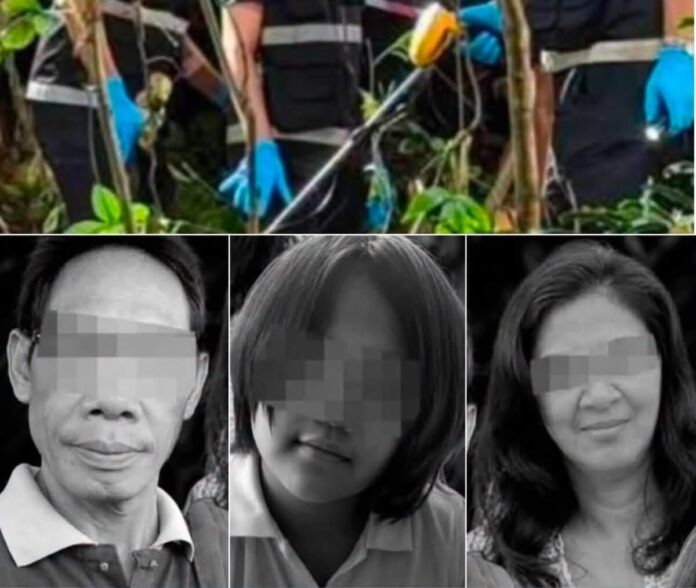
PATTAYA, THAILAND – The Wongsa family begged police for help. Four weeks. Nothing. Wichian Wongsa (53), his wife Chanthana Chatrin (50) and daughter Nichapa (18) vanished from their Huai Yai home on July 6. Relatives filed a report the next day at Huai Yai police station – the same station that later scrambled to find Diana and Roman Nazimova.
That is not an accusation. That is the file. The sister of murdered Chanthana told Thaiger on August 2 how the weeks after the report unfolded.
Police asked if missing woman had a lover
She asked repeatedly about the investigation. No answer. No progress. When she pressed the officer who took the report, he fired back a single question: whether the missing woman might be with a lover.
That was the response to three people vanishing at once. All vehicles still parked at the house. No sign of a struggle. No missing valuables. And a cop asked about a lover.
Missing Russian siblings got posters, Thais got nothing
At a nearby convenience store, she later saw posters looking for Diana and Roman Nazimova. She wondered why her sister, brother-in-law, and niece apparently weren’t worth the same effort.
The answer is obvious, even if nobody says it out loud: the Russian siblings had an embassy behind them. The Wongsa family had only their relatives.

July 6: The pattern plays out for the first time
What happened that evening in Huai Yai has now been reconstructed through confessions and forensic evidence. Four men entered the Wongsa home, posing as police officers investigating drug allegations.
Wichian was handcuffed. Chanthana had her wrists tied with rope. When Nichapa returned from her shift at a convenience store, she was detained too. All three were loaded into the family’s own pickup truck and driven to a coconut plantation.
Thong dug the pit – for nearly two hours. Then all three died: Chanthana first, then Wichian, then Nichapa. The four killers drove the pickup back, parked it in front of the victims’ house as if nothing had happened – and stole the family’s Honda Wave motorbike.
All three found in one shallow grave
When the bodies were discovered in early August, all three lay in the same pit, barely 1.5 metres deep. Wichian’s handcuffs were still locked. The rope still clung to Chanthana’s wrists.
Twenty days passed between the murder of the Wongsa family on July 6 and the disappearance of Diana and Roman Nazimova on July 26. In that time, the Huai Yai police station could have taken the relatives’ report seriously.
Police could have tracked phones but didn’t
They could have tracked the missing people’s phone numbers – a right that, according to the sister, only police have, not the family themselves. They could have spotted the pattern: three people gone, all possessions still there, no fight, no explainable absence.
Instead, Pong and Thong roamed the area unbothered for three weeks. When the Russian siblings rode their motorbike just after four in the morning on July 26, the same men were waiting for a new opportunity.
Did Thai victims get treated worse than foreigners?
The question gripping Thailand – whether police react differently to Thai victims than to foreigners – is not rhetorical. It has a concrete answer, one you can measure in bodies.
Shortly after the Thai victims’ identities became known, reports circulated that Pong went after the family because of drug debts. The sister of murdered Chanthana rejected that flatly on August 2.
None of the three killed had anything to do with drugs. Pong apparently used the method of posing as police and using drug allegations as a pretext routinely. The family was a random victim, not a convicted debtor. The dead can no longer defend themselves – I am doing it for them now.
said the sister of Chanthana Chatrin.
System failed before the murders too
In early 2026, months before the Nazimova case and months before the Wongsa family murder, the Mirror Foundation (Krajok Ngao) – one of Thailand’s best-known civil society organisations in the missing-persons field – formally requested a meeting with the Royal Thai Police Headquarters.
The topic: the broken missing-persons reporting system, the handling of unidentified corpses, the data management. The appointment was rejected. No meeting. No response.
Activist confronts police chief over double standards
That is the background against which Huai Yai police station handled the Wongsa family’s report in July 2026: a system that refused reform, with officers who brushed off a family’s report with a question about affairs. And three corpses proving what comes of it.
Gan Jompalang, a well-known activist in Thailand, appeared in person on August 2 at the Chonburi police chief’s office and brought Wongsa family relatives with him. His question was clear.
Why are there two standards – one for foreigners, one for Thais without international lobbying?
said Gan Jompalang, activist. An official answer that would have addressed that question has not been made public so far.
Police colonel met the group but no answers yet
What is known: Pol. Col. Warawut Nittayawan, chief of Huai Yai police station, received the group. What follows from that meeting remains to be seen. The investigation against the four perpetrators is ongoing, all are in pre-trial detention, bail has been denied.
That does not change the fact that the Wongsa family waited a month for investigators who never called back.
Chonburi police deny suspects are officers’ children
Alongside the debate over two-tier investigations, claims circulated on social media and in some outlets that went further: the four suspects were sons of police officers, had close ties to police, or even acted on police orders. Chonburi provincial police responded on August 2 with an official written statement.
The result of the internal review: In the personnel database, the investigative files, and the available evidence, no proof was found that any of the four suspects is the child of a police officer, has close ties to police, or acted on officers’ instructions. The investigation proceeded according to the evidence and legal principles, without favouritism.
Tips from the public that prove the opposite, the authority says, are welcome.