
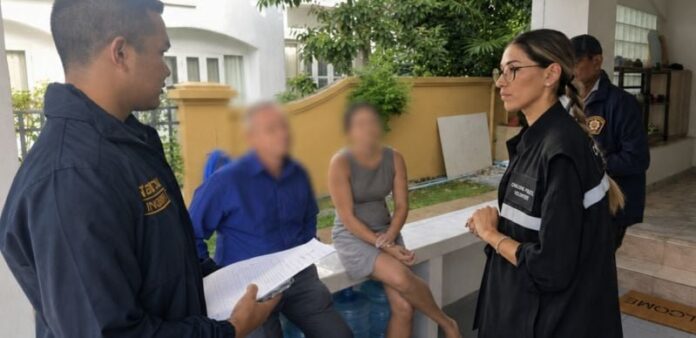
PHUKET, Thailand – Cops smashed a hidden foreign control network on the holiday island, nabbing 16 suspects in a series of dawn raids. They targeted firms where Thais are just fronts for foreign cash.
The operation kicked off on 6 August under the name “Operation Dismantle Foreign Nominee Network in Phuket, Phase 4”. Cops raided eight locations across the island.
16 arrested in Phase 4 of the raids
Among the 16 suspects were ten Thais, two Canadians, three Russians and one person from Kazakhstan. All were taken in on active arrest warrants.
Six more people remain under investigation for possible further prosecution, according to police.
Raids hit rental firms and schools
Detectives tore through companies across multiple industries. The list included car rental firms, motorbike rental shops, car washes and vehicle detailing businesses.
Also caught in the net were language and international schools, restaurants, IT app developers, electronics shops and pharmacies selling traditional Thai medicine.

361 firms checked over land ownership
The current action is part of a wider probe into companies linked to foreign land ownership on Phuket. Authorities are checking 361 companies together with the Phuket Provincial Land Office and its branch in Thalang.
Police said proceedings have been launched against 114 companies. Courts have slapped fines on 39 firms. In addition, 15 rai and 13 square wa of land have been forcibly sold under legal procedures.
Foreigners hold more than half in 149 firms
Authorities have so far identified 149 legal entities that own land where foreign shareholders hold more than 50 percent of the shares. Proceedings to sell off the land have begun.
In the Phase 4 investigation, detectives identified eight nominee firms. That pushed the total number of proceedings against such companies up to 31.
More than 11,000 foreign-run firms
On Phuket, 32,024 legal entities are registered with a combined capital of around 240.6 billion baht. Of those, 11,078 firms are considered foreign-run. That works out to 34.59 percent.
Police say possible circumvention includes Thais formally holding at least 51 percent of shares while foreign investors provide the real cash. Effective foreign control over voting or management is also being probed.
6,682 firms flagged as high-risk
Authorities have ranked 6,682 companies in six sectors as high-risk. These include tourism, land and real estate, e-commerce, transport and storage, hotels and resorts, and agriculture and construction.
Most foreign-run firms are based in Mueang district, where 6,073 were counted. Thalang follows with 2,670 and Kathu with 2,335.
Tighter checks on company registrations
When registering firms with foreign participation, authorities now demand bank statements from the past three months. This lets them match actual investment funds against the declared value of business shares.
Also checked are shareholders, money sources, possible risk or nominee accounts, and business premises. If more than five firms are registered at the same address, they must prove their right to use the space. Accountants or lawyers must confirm the firm’s identity through the official registration system.
62 cases registered with police
After registration, authorities watch for further warning signs. These include foreigners with less than 50 percent of shares who still control the firm, business areas banned for foreigners, contradictions over the real capital provider, and people who run multiple companies.
Currently, 62 cases linked to suspected Thai nominee shareholding are recorded on Phuket. Five cases ended with court verdicts, four are pending in court and 53 are still under investigation.
Fewer new firms with foreign capital
After the stricter checks were introduced, the number of newly registered legal entities with foreign participation dropped by 57.64 percent, according to police. At the same time, the number of liquidations of such firms rose by 20.65 percent.
Investigators want to keep checking ownership structures, money sources and control relationships. The goal is to prevent foreigners from bypassing restrictions on business and land ownership through Thai shareholders.
said police.