
UTHAI THANI, Thailand – A forest guard was killed in a rare tiger attack at Huai Kha Khaeng Wildlife Sanctuary. Authorities are hunting the animal and have suspended tourism in the protected area.
Sakarin Wichachan was sleeping under a mosquito net in an open shelter early Wednesday when the tiger struck. The beast lifted his body over a low railing and dragged him about 200 metres from the bed.
DNA traces to identify the tiger
Investigators collected tiger hairs and other DNA evidence at the scene. The material will be compared against samples from up to five tigers living in the area.
The tiger that attacked Sakarin remains unknown. Officials hope forensic analysis will match the killer to a known individual.
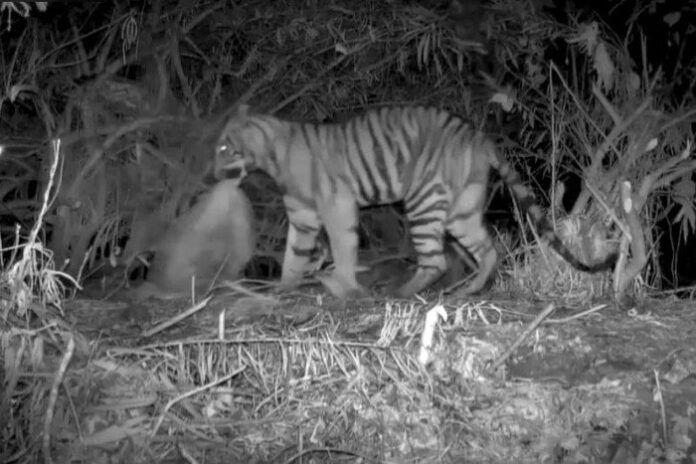
Young tiger ‘Roi Et’ caught on camera trap
A camera trap recorded a previously unknown young male tiger. The animal does not yet appear in the Thailand Tiger Project database.
Researchers gave it the temporary name Roi Et. The name refers to the Thai number 101 – if confirmed as a new individual, it would be the 101st tiger photographed at Huai Kha Khaeng. Whether it carried out the attack remains unclear.

No signs of struggle at the shelter
The guard was sleeping in a building with open sides and a low railing. Tiger tracks had been found repeatedly along a path next to the shelter before the attack.
Inside the sleeping area, investigators found no evidence of a struggle or blood. The mosquito net was smeared with blood, and the body later showed signs of feeding after death. An autopsy and forensic examination will determine the exact circumstances.
Sanctuary tightens security measures
The Department of National Parks, Wildlife and Plant Conservation has launched a full investigation. Visitor access to Huai Kha Khaeng Wildlife Sanctuary has been suspended. The DNP ordered five immediate actions.
More personnel now patrol around stations and offices. Additional lighting is being installed at shelters and work sites. The agency is coordinating more closely with surrounding communities and monitoring the area continuously.
Warnings for rangers and communities
Staff have been told to avoid high-risk locations. Authorities also plan to tighten coordination with nearby villages.
Officials are reviewing whether ranger shelters in remote forest areas need structural changes. Open shelters are practical in tropical conditions but may offer too little protection where large predators are present.
Tigers normally avoid humans
Experts from the Thailand Tiger Project say wild tigers usually retreat when they sense human movement. The current case is considered extremely rare.
Authorities warn against concluding that tigers are now targeting humans. First, they say, the exact animal involved must be identified before deciding further action.
More tigers seeking new territories
An estimated 177 Indochinese tigers live in Thailand. In the Western Forest Complex, the number rose from 42 to 79 over the past decade.
Young males in particular travel long distances looking for their own territory. Adult male tigers need an average of about 267 square kilometres when existing territories are already occupied.
Wichit and HKT178 travelled far
Previous observations show tigers from Huai Kha Khaeng moving into neighbouring protected areas and beyond. The tiger Wichit crossed several provinces before returning to suitable forest.
Male HKT178 reached Lampang, where he was found seriously injured after being shot. Researchers later suspected an infection and possible vision loss, which may have impaired his natural hunting ability.
First fatal case in many years
DNP Director-General Athapol Charoenshunsa said he recalls only one similar attack on a park employee in nearly three decades. In 1998, a staff member survived a tiger attack in Khao Yai National Park after colleagues scared the animal away with warning shots.
The attack in Huai Kha Khaeng is the first known fatal tiger attack on a park employee in many years. The DNP is supporting the victim’s family financially and awaiting the results of further investigations.